Sunday, August 31, 2008

Sou'western Coast

The fog had settled in on us in the gravel pit, but by morning, all that was left was the dew. We jumped back on the bikes, had a beautiful and uneventful ride, and for what seemed like the first time this whole trip, we made it to our destination ahead of our predictions!

We were so excited to be arriving to this lovely coastal town, we had to take a picture.
Things only got more exciting from here on out. On the edge of town, we reached a grocery store bigger than we ever expected to find in such a little town (population 1700, or 2000, depending on the sign). It being the 3rd day since we'd seen a store (or basically any sign of civilization), we clamored inside, wide-eyed like kids in a candy store. In a way, we were kids in a candy store, for we went straight to the candy bar section and loaded up. Outside on the bench, we shared Reese's Peanut Butter Cups, Humpty Dumpty Chips (off-brand and better version of Cheetos), carmel bars, etc. We did this to give us ample energy for the real shopping we were about to do and, more importantly, to stay in accordance with the ancient law: don't shop hungry. (We take this one very seriously.)

We then stocked up on real groceries and went to the harbor. After eating again (popcorn and veggie deluxe sandwiches), a nice but unintelligible man somehow managed to convey the message to us that if we haven't seen Sandbanks Park, we haven't seen Newfoundland. We were skeptical, but there's something about a very insistent unintelligible man that makes it hard to say no. Maybe the fact that we weren't sure if "no" meant the same thing in Newfie speak. We exaggerate a little, but Newfies really do have a strange way of talking. This guy was such an extreme example that Nick couldn't resist snapping a video in the car (he apologizes for the shoddy camerawork--it's the audio he was looking for).


Anywho, we checked out the Sandbanks, which though nice, were not as entertaining as the company in the car ride itself, and made it back to the harbor in time to catch our ferry. Our stay in Burgeo was bound to be short, but we were onto something more exciting: Ramea.

Ramea is a small island, both in population (462) and size. We climbed to the top of Man o' War Hill and took a picture of the town.
And the sunset was lovely too.

We were excited about this island not just because of its beauty and remoteness though. We had made contact with some folks from warmshowers.org, a website for traveling cyclists, and they had agreed to welcome us into their home. Jim and Judie, it turned out, were about as excited to see us as we were to see them, and lucky for us, they turned out to be the coolest retirees on the sou'wester coast of Newfoundland, bar none.

Life on the island is pretty slow and they were happy for the change of pace. They shared a wealth of knowledge with us, and pretty much waited on us hand and foot. If our stomachs hadn't been so delighted about it, we might have felt guilty. Dominic and Gretta, confronted with the serious matter of tackling so much food, had little time to smile.

The next day, we were socked in with fog and rain, but we used the time for some serious rest and recuperation. We took a lazy jaunt along the boardwalk that encircles the island, rummaged through the dump for a rear wheel axle for Nick (no luck, but it was fun jumping from pile to pile in the rain), and visited the fish plant, which has recently been converted to a whelk plant. Gretta was brave enough to sample the whelk (a type of sea snail) off the assembly line, though she only made it so far before spitting it out. Nick thanked his lucky stars he was born with the ability to close off his nasal passage without using his fingers. (T'would have been rude, you see.)

Our hosts' warm house provided sanctuary against the elements, and our stay in Ramea was lovely. Thanks Jim and Judie for everything!

A Lesson in Aerodynamics

In this post, we are going to talk about one of the primary principles of physics that governs how people ride their bicycles on planet earth. If you have a strong aversion to simple math, then you might consider skipping this section. But if you want to know more about the main strategy behind smart biking, or even how to improve the gas mileage of your car, then read on.

Let’s start with the topic of racing. If you know anything about bike racing, you know that big races, like the Tour de France, are a team sport. Most of the time, the team rallies behind one racer (their strongest) and they all work together to help that racer win. How do they do this? Well, there is a lot of strategy involved, almost like a chess match, but there is also one basic physics principle that makes teamwork preferable to racing as an individual. Nick, the physics major that he is, insists on explaining this to you. Hope it makes sense.

Wind: What a Drag!

The reason, in a word, is wind. We have both touted and complained about wind to you on this trip, and it turns out that wind is paramount in the world of biking. Specifically, we are talking about wind resistance, or drag, as it is called in physics. This is the force of wind that pushes against you as you move, and it can happen in two ways: the wind is blowing naturally, or you start moving yourself and create your own wind. In the latter case, it is important to point out, the wind you create always blows against you, and it gets stronger that faster you go. (Boo.)

So drag gets stronger when the wind gets stronger. That seems obvious, so what’s the big deal? If you just bike harder, you’ll go faster and get there quicker, so doesn’t it all just even out? Unfortunately, the answer is no. Drag does depend on your velocity (speed), but not in the way you might think. It turns out that the force of drag increases as the square of your velocity. Let’s freak you out a little more by throwing in the formula, and then we’ll break it down.

F = (k) x (v^2)

F is the force of drag.
K is a just a number and it changes depending on things like your shape, size, the fluid you are flowing in (in our case, the fluid is air), etc.
V stands for velocity
^2 means squared, normally a little number 2 up above, but we couldn’t type that (v^2 = v x v, just like 2^2 = 2 x 2)

It is exactly that square that causes all the trouble. That means at lower velocities, the drag isn’t so bad, but at higher velocities, the force against you starts getting huge, and making headway becomes more and more difficult. Let’s calculate F with some easy numbers to make it real.

Ok, easy numbers…for all of these examples, let’s say k = 1.

Now let’s do a low velocity example. Let’s say your velocity is 3, v = 3. Plugging in the numbers,

F = 1 x 3^2 = 1 x 3 x 3 = 9.

We’re leaving units (like mph, for example) aside right now, but the number 9 is a measure of how hard the force of wind resistance is pushing against you. Savvy?

Now let’s say you want to increase your velocity by 2 units, from 3 to 5. What do you think will happen to the force? Will it increase by 2 also? Let’s plug in and see.

F = 1 x 5^2 = 1 x 5 x 5 = 25.

An increase of 2 in velocity made for an increase of 16 in force. Bummer dude! But if that’s not bad enough, let’s try an example at a slightly higher velocity. Let’s say you want to increase your velocity by 2 again, this time from 10 to 12. Plugging in 10,

F = 1 x 10^2 = 1 x 10 x 10 = 100.

Plugging in 12,

F = 1 x 12^2 = 1 x 12 x 12 = 144.

At this speed, increasing your velocity by 2 means the drag increases by 44. Major bummer!

What are the real world implications of this? Well, the first one you’ll find relevant has to do with driving your car. Did your parents ever tell you that driving at 55 mph gets you better gas mileage than driving 80 mph? Did you think that maybe it was just a self-serving ploy to get you to slow down? Well, for you speed demons out there, sad to say it’s true. The amount of extra energy you expend with that 25 mph increase is huge.

The real world implications for us bikers are significant too. The obvious one is that fighting the wind is a pain, and if the wind isn’t going your way, it can mean the difference between 1 day to get somewhere and 3. This makes planning almost impossible for the cycling tourist.

Fighting Your Own Wind

But even on a windless day, bikers routinely move fast enough to create their own wind, so there are lessons to be learned.

The first is that pedaling your heart out to get from 25 to 27 mph is a waste of energy! You are better off pedaling your heart out up the hills, where the wind you are facing is less, and then coasting down them. Dominic’s grandfather was a strong believer in this strategy, and won the Classics Division of the Tour of the Gila (a 4-day stage race in our homebase of Silver City, NM) doing just that. Pedal up, coast down.

Lance Armstrong may or may not like the wind, but it is the reason he routinely won the Tour de France and other stage races that involve many days of racing. In racing, there are two types of racers—climbers and sprinters. They use different sets of muscles that work at the expense of each other. So good climbers make poor sprinters and vice-versa. On the flat stages, the riders stay in a pack, and then at the end, the sprinters make a break and pedal like the dickens. This is where you see those dramatic finishes where bikes are flailing all over the place and they lunge forward at the last second to best their opponent by a few milliseconds.

The mountains are where the climbers shine, albeit at a slower speed. As we now know, slower means less wind resistance. So with little wind resistance, the strong climbers maintain a small advantage in speed, and after several hours it begins to add up. The racers who fell behind try to make it up on the downhills or the flat ground, but alas! As we have already seen, fighting the wind for an extra 2 mph at high speeds is a lost cause, even if you are a superb sprinter. The sprinter may have bested the climber by a few seconds in the flat stage the day before, but in the mountains, multiple-minute or even multiple-hour leads are established, and it’s the overall time that wins the race. Any guesses what kind of racer Lance Armstrong is? That’s right, he’s a climber.

So why do sprinters even bother racing? Well, there is some chance for glory. Each day (or stage) is a mini race unto itself, and on days when the course is mostly flat, sprinters get a chance to show their prowess for speed and win that day’s race. There’s glory in that alone, but if you’re really good, you might just win more stages than the overall winner. Ironically, it is actually possible for a cyclist to win the entire race without winning the most stages, or even one stage, for that matter. Seems unfair, but not any more so than the electoral college.

Wiiiiiiiiind, Keep Us Together

The other reason that cyclists other than climbers still participate in the race has to do with another physics principle—drafting. This is where you hug tight to the rider in front of you and use him or her as a wind block. This makes riding a lot easier for the rider behind. Oftentimes, racers will work together and rotate out, each taking a turn fighting the wind at a hard pace while the other one hangs on behind and rests. This eventually turned into a team game, so that nowadays teams will work together to help “pull” their strongest rider along on flat ground and downhill (where wind is the strongest). When all the teams are racing, they hoard together in what’s called a peloton (French for “pack”). This is the big group of riders you see in photos, and riders take turns pushing the pace at the front and then dropping back when they get tired to let someone else take over. It’s hard to quantify just how much faster or more efficient this technique is, but let’s just say that pro riders often average 30 mph or above, while on our best day, we averaged 18 or 19. It’s an all-out blitz all day and they friggin’ fly!

The strategy for racing gets complicated from here on out, but usually a group of riders will make a break and try to leave the peloton behind. If you do it right, your rider or your team will be in this breakaway, and if your timing is just right, you might just make it all the way before you get caught. Easier said than done, for the peloton is a force to be reckoned with.

Our Wind Strategy

We are a far cry from elite racers, but we too have been trying to use physics to our advantage. On the uphills, we ride however we like. But on downhills, flats (few of those so far), and windy days, we form a line and take turns pulling each other along.

You’d be surprised, but this makes a huge difference. On hills, we form a tight line and the person in front pedals hard, “pulling” the other two along. With this windbreak, the riders in back end up braking more than they do pedaling. They focus on staying tight (sometimes within a few inches of the wheel in front) and watching and listening for visual and verbal commands from the leader, swerving around potholes and feathering the brakes just the right amount. The front rider does this till he or she gets tired, falls off the side, and the other two bump up in the rotation. Onward we go!

We are generally pretty low key about our riding, but on days when we face an onslaught of wind or need to cover a lot of ground, this strategy is critical, and it saves us lots of energy.

We’ll do a post later about riding as a team, but for now, hope you enjoyed the physics lesson!

Saturday, August 30, 2008

The Long And Lonely Road

After feasting with Ryan, we feasted again in the morning. He cooked up one of the staples of veganism: tofu scramble with potatoes. He must have used some sort of potion on the potatoes because we all agreed they were the best potatoes we’d ever had. He then added a touch of Newfoundlad cuisine: the Touton. These are doughy biscuits that are fried and then covered in molasses. Here they are, frying away in the skillet.

We also met an interesting chap from Australia who started the “Who Is Happy Guy” group on facebook. He was couchsurfing with Ryan and the lot of us had a jolly old time together.

Loop or Bust

After being thwarted in our attempt to make a loop up north, we decided to try again down south. This would be the last leg of our journey in Newfoundland and it would involve some of the most remote areas yet. So after getting Nick’s wheel fixed, we stocked up on several days worth of provisions.

If all went according to plan, this next phase would take us to the town of Burgeo, on the southwestern coast of Newfoundland. It was 200 km (125 miles) from Corner Brook and not a town between. It was a long road. We left Corner Brook in the afternoon and made 50 km in good time to the turn off. Here we bid adieu to the noisy and trafficky TCH (Trans Canadian Highway) for what we hoped would be the last time. Our shadows grew longer, and we followed them west down the 150 km stretch of nothing.

As Gretta points out in this video, 'twas a truly lovely road indeed.


We found a spot to camp and addressed a noise that Nick's bike had been making ever since leaving Corner Brook. We have become well practiced at detecting and deciphering noises on our bikes, and we consider ourselves experts now at diagnosing problems with our ears only. But this one had evaded us all day. Upon taking Nick's rear wheel off the bike, we discovered a shocking fact: his rear axle was broken in two. After marveling for some time about the fact that this hadn't immediately resulted in disaster, we tried to figure out what to do. We knew we were not equipped to deal with this at the moment, so we placed the wheel back into the bike. As night fell, we weren't sure what the morning would bring, but we hoped for the best as we went to sleep.

The next day, we figured we were better off limping the bike into Burgeo than trying to head all the way back to Corner Brook. After all, it had broken somewhere along the way and was still running. So we would carry on, closely monitoring the noise and riding carefully. Worst case scenario, one of the 10 cars we would probably see on this remote road was bound to give us a ride if we needed it.

Mid-way through the day, the noise got worse, and his wheel started to develop a wobble. We took the wheel out again to take a closer look. We couldn't take too close of a look though, because taking it apart could have resulted in greasy bearings falling every which way. Figuring that the two pieces of the axle were not lining up quite right, the best we could do was attempt to realign them by feel. We did so and carefully reattached the wheel.

Wouldn't you know it, but the noise disappeared and the wheel spun truer than it had virtually the entire trip. Onward ho!

We started chipping away again, hoping to make it the rest of the way to Burgeo. And then, another strange thing happened. Something we had not encountered the whole trip: heat. We guarded against this by jumping, fully clothed, into one of the hundreds of ponds we came across along this road.

It was refreshing, but between still-sore legs (from scaling the highest peak in all of Newfoundland) and what we now figure was a mild case of heat exhaustion, we didn't make it as far as we hoped. In the evening, the fog rolled in fast, reducing visibility and within 20 minutes we were freezing. We used this as a convenient excuse to call it quits for the day.

Easier said than done, however, for the landscape offered nothing but miles and miles of peat moss bogs and grassy puddles. We rode on, with an increasing sense of anxiety, till we stumbled across the Newfoundland camper's paradise: a gravel pit. We had been told, "You haven't really camped at all in Newfoundland till you've camped in a gravel pit," so we took the advice. It was our only option anyway. We feasted, and we slept.

With some luck, the next day we'd easily make it to Burgeo, which, according to our calculations, was some 40 km away.

Friday, August 29, 2008

Cooking

For those of you who have been wondering what and how we have been eating, we thought we'd dedicate a little section to this specific topic.

You might have pictured us toiling away in the saddle, slaving up mountains and burning calorie after calorie only to come home to oatmeal and ramen. Not so! The first part is accurate, but in truth, we have been living high on the hog, as far as food goes.

Our mobile kitchen seems to get more and more elaborate each trip. Ten years ago, it was just a pot, pan, and small camp stove. This year, we have replaced the small frying pan with a cast iron skillet (thin-walled, so it's not too too heavy, but ask Gretta, she's been carrying it the whole time) and we have added to the repertoire, nothing short of a pressure cooker!


We do only have one burner still, but you'd be surprised at some of the feasts we have cooked up given our limited supplies.

One of Nick and Dominic's favorite meals from their last bike trip was the breafast burrito, which they invariably managed to make almost unmanageably huge. On this trip, we first attempted to repeat this while in Corner Brook, but after realizing that tortillas are a prohibitively expensive commodity reserved only for the wealthy ($4 a package!), we had to alter our plan. The new ingredients were egg, potato, avocado, salsa, and...bread. Breakfast burritos a la Canuck (or, in Dominic's Spanglish, a la "Canadensien,") we call them.


We are mastering the pressure cooker too though, and our meals lately have frequently involved some type of grain (rice or barley), a legume (beans or split peas), and some veggies (potatoes, carrots, etc.).


We simply throw this in, heat until the pressure release starts hissing (about 10 minutes), turn the burner off, and let it simmer inside. If we're feeling particularly chilly during this waiting period, we'll whip up some hot chocolate to accompany our group reading of "The Boat Who Wouldn't Float," a hilarious tale about a man who sets sail in Newfoundland in a rickety old boat. When we open up the pressure cooker we pour a couple other things in that serve both for flavor boosting and temperature regulation (bringing the heat down from the 300-400 degree range to the more manageable range of 150-200, cream of mushroom soup has been working well for this) and voila! Ready to eat! Some cold cheese chunks as garnish step this meal up a notch from delicious to divine.


Against our best efforts, we have been snacking on things like cookies and candy bars, but occasionally we'll undertake something a little more healthy, like popcorn, of which Gretta is the master.


On our way back through Corner Brook, we stayed with Ryan again and cooked up a delicious vegan feast to share with him. Shepherd's pie, and the delicious chocolate cream pie we referred to in the posting on berries.


But by far the most glorious so far involved both the pressure cooker and the cast iron skillet: homemade cherry syrup (the cherries we picked ourselves, you'll recall), and pancakes! The one item lacking for this process was a good spatula. But no matter, we have a semi-flexible knife, and love the challenge of flipping pancakes in a cast iron skillet. Check out Gretta in this video.


Hungry now? We sure are!

In fact, as Dominic looks at the screen, he is currently contemplating pedalling back up the hill in the wrong direction before we leave town so that we can add some cheesy goodness to our dinner tonight. Oops there he goes!

Thursday, August 28, 2008

Heading South

It took us 3 days fighting the wind to make back what we had covered in our 1 day, but we eventually made it back to Gros Morne National Park. This was nice, since we had missed out on hiking Gros Morne Mountain, which, at 806 meters, is the highest peak on Newfoundland. It was supposedly the hardest hike in Gros Morne, but we saw it as a good chance for cross training.

The sign said it would take 6-8 hours. Fit and young as we are, we figured we had it nailed in 3, 4 tops. Turns out these Canadians don't pussyfoot around with their signs like they do in America. It was a steep climb, so much so that we jokingly decided that the record time for the hike by an elite ultramarathon runner must have been somewhere around 5 and half hours. This sign was a bit of an exaggeration, but not too much.

It was a steep rock slide in all senses. On our way up, we heard water flowing underneath, which did little to assuage our concerns about how slippery this slide really was. Fortunately it held for us, and we made our way up through the fog.

The fog can get so thick that hikers who venture off the trail for whatever reason sometimes never find their way back. We were sure to follow the clear markings, and this brought us all the way to the top, where it was cold and windy, and relatively clear, though not by the standards we're used to.

It was a beautiful hike, and all in all it took us about 7 hours to do the whole thing. We were feeling disappointingly average by Canada's standards, so to make up for it, we hopped on our bikes and then took on the steepest mountain we had seen yet. (We had avoided it before by taking the southern route into Gros Morne and ferrying across Bonne Bay.) It took us all 45 minutes to an hour of non-stop cranking to get to the top.

We made it though and coming down was glorious, as always. It also got us that much closer to Corner Brook, where our new friend Ryan from couchsurfing was, with any luck, still alive, well, and ready to receive us.

Wednesday, August 27, 2008

Resettlement

So back to the timeline. We were flying north to St. Anthony where we'd catch a ferry back down. The kilometers rolled by. We mandated breaks every 20 km to keep our fuel supply well stocked (by eating, that is), and this worked well.

135 km in, we stopped in Hawke's Bay to see if we could find out the schedule for the ferry. If it only ran once a week, that could throw a serious wrench in our plans. What we found out was even worse, however. The St. Anthony ferry no longer ran. Our suspicion was that the ferry from Labrador to Lewisporte (Newfoundland) stopped in St. Anthony, but after talking to the company itself, we realized no such thing took place.

Canada's Resettlement Program

Newfoundland has long been a one-industry island, and that industry has been codfish. The history is long and complicated, and we don't pretend to know that much about it, but we know the basics. Newfoundland almost incorporated as part of the United States after WWII, but ended up striking a better deal with Canada. Joey Smallwood negotiated the deal, and older Newfies still look up to him because they immediately saw benefits. Cash, pension plans, infrastructure deals, etc. But the codfish industry has been badly mismanaged by Canada, and in 1993, codfishing was entirely banned. It's only recently been opened back up, but has severe restrictions on it.

This all but destroyed the way of life and source of income in all the fishing communities scattered around the entirety of the Newfoundland coast. The ferry services that Canada had been subsidizing suddenly seemed a great burden, and they started looking for ways to "modernize." The government came up with resettlement. Move the families, house and home (literally move their houses, or buy them new ones), into the urban areas. This proved highly controversial, esp. since communities had to reach near consensus in order for it to take place. Communities were divided and there are stories of houses being burned down in order to reach the 98% agreement or consensus to resettle.

Other than being an interesting (though sad) chapter in Newfoundland's history, it is relevant to us for one reason: many of the ferries have stopped running.

With St. Anthony out of the picture, our last hope was to catch the ferry from Englee (eeng-LEE) and hug the coast down to Great Harbor Deep and Jackson's Arm.

Turns out, Great Harbor Deep is one of the few communities that actually resettled, and the ferry stopped running within the last year.

Wind Out of Sails

After clippping along so efficiently toward our goal, we found out this new info and, as you can imagine, we were suddenly completely emotionally deflated. We had no choice but to head for the next sizeable town, regroup, and figure out what to do.

This town turned out to be Port au Choix, and when we rounded the corner to head there, the emotional blow we took became physical: the wind turned against us. The last 20 km were eeked out at a crawling pace. We struggled up one of the steepest hills yet with a 25 km/hr headwind, and limped into town.

It was a grey and dark hellhole, Nick assures this ambiguously voiced blog writer, and we spent several cold hours debating what to do. Part of that time we wasted in a dreary pub that was empty but for two sad souls squandering their money on electronic slot machines. On one of the empty machines, we noticed a marquee scrolling across the screen giving advice to people with gambling addictions, which, though appropriately placed, seemed ridiculous and mocking.

We ended up camping on a peat bog (the picture you saw before), which took us a while to find and more time to push our bikes up to. Strange voices filtered our way--seemingly from children. With the sun just setting and the wind still full force, we checked our odometer for the day--remember we were trying to make 100 miles--and realized we were just short: 99 miles. The only silver lining was for Nick, who because of his trip back to camp that morning to recover his camera and iPod, made the century day with the extra 10 km he rode.

We we thwarted in our attempts to make a fire, so we cooked dinner on the camp stove and decided to give in to the ferry gods. We would go back down the way we came, and face the onslaught of wind.

Tuesday, August 26, 2008

Scenery

Here are more pictures of some of the stuff we've run across along the way.

Before leaving Gros Morne for St. Anthony, we were blessed with some beautiful sunsets where we camped right on the beach.


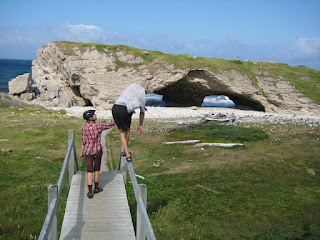
We also had the fortune to visit Canada's version of Arches National Park (actually, it's Provincial). A different kind of arch (not landlocked), but fun nonetheless.


We ran into a friend from the previous night we had made at our camp site. He was traveling with his parents by car, and as fast as we were booking it north, they caught up to us. After a warm reunion, we left him at the arches. Our last site of him was in a headstand on top of the arch.


Vegetation

As we may have mentioned before, the landscape around here is interesting. In some places, it's wooded forest so thick you can't enter at all and in others, it's boggy marsh. The marsh is the more interesting to us, probably because it's more foreign, and we actually had the chance to sleep on a peat bog.

This is marshy territory where your steps literally sink in several inches. When someone walks by you, or you drop something, the ground literally shakes, as if a semi has just gone by. Freaky.


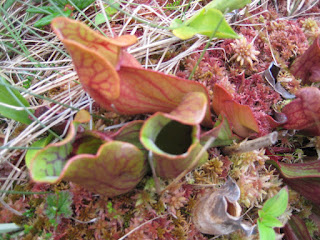
But freakier than that is some of the vegetation. The peat bogs, which spread over millions of years and actually take over treed areas (backwards from the traditional succesional process) are up to 15 feet deep, and contain water that is cold, acidic, and low in oxygen and nutrients. If bodies from millions of years ago have been found in them perfectly preserved, you might wonder how things grow. Some of them have taken to eating animals. The pitcher plant, for instance, creates perfect little pitcher-shaped leaves for trapping water, and with it, unsuspecting bugs that dip in for a drink. They fly in, get wet, and can't grab a hold of any firm ground to dry themselves off. Once they have drowned, bacteria that live in the plant help digest it.


Here is a close-up, looking inside the pitcher. You can even see some little hapless bugs down there. We'd feel sorry for them, except that one at least looks like a black fly. Good riddance!


Animals

So far we have seen several moose, and Nick saw a black bear barrelling down the mountain. Fortunately, it was barrelling down the mountain away from him. Not enough time for a picture, but here is a young male moose we saw off the highway in Gros Morne.

We also ran into some rather tourist-friendly birds at Western Brook Pond, a grand fjord in Gros Morne. We couldn't help resist the temptation after we bought some nuts.


The bumblebees here still appear to be in good shape too.


And of course, we are constantly blessed with sunsets to die for. Pictures don't capture it all, but hope you enjoyed the taste. Ta-ta!


Update on the berries

We have discovered that what we ate was actually the bakeapple berry (also known as cloudberry). Just thought we'd let you know, in case there were any parents still worrying. Still haven't found a patridgeberry.